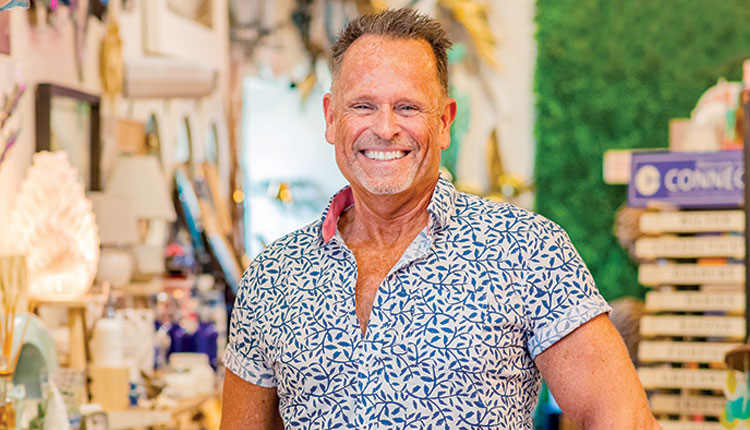
Ordinary is overrated, if you ask Howard Aspinwall, who welcomes guests to “chaos curated in the best possible way” at Mellow Monkey Gifts & Decor in Stratford, Connecticut. Visitors expecting a typical shoreline retail store will find anything but the same-old at Mellow Monkey, an unassuming yet loud-and-proud flagship located in a warehouse with a regular beat of loyal followers and visitors who make it a destination.
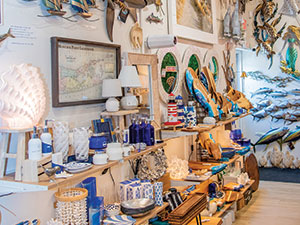
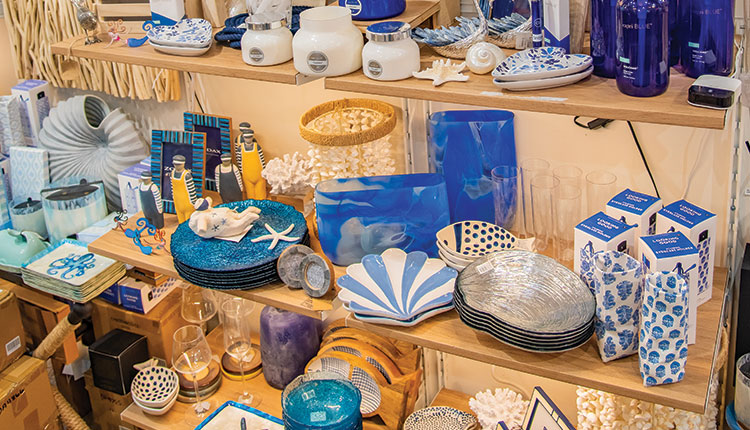
Customers get lost in a sea of coastal decor from beachy frames to seashell shaped plates and seaside scents.
Photos: Laura St. John Photography
Many guests have experienced Aspinwall’s delightfully gregarious, no-filter social media feeds before they land in the 3,500-square-foot, triple showroom industrial space. It outfits the brand’s in-store and online businesses.
“Go ahead,” Aspinwall wages in an Instagram reel. “Tell me your most challenging gift need and I’ll tell you the perfect gift to give.”
Then he plays the role of a shopper. “I’m looking for a gift for a friend who says she’s deeply connected to the moon, even though she once confused it with a streetlight.” (Drips with sarcasm.)
“Don’t worry,” Aspinwall reassures his vast social media audience in the clip. “I have just the thing.”
He dangles a Moonglow necklace in front of the camera, one with customizable lunar phases reflecting special dates: a birthday, anniversary or “the night you confidently mistook a streetlight for a celestial event,” he quips.
“Our social media presence drives conversion, mostly because of my antics,” Aspinwall relates.
To be sure, at Mellow Monkey, you can “come for the gifts and stay for the laughs,” says Aspinwall, who is a lot of fun — but no games as a serial entrepreneur. He has grown a fledgling online venture into an immersive retail bonanza.
The store has a personality of its own. And like any good host, Aspinwall’s goal isn’t just to sell — it’s to connect. “I want people to feel something when they’re here,” he says. “If they leave smiling or smirking, I’ve done my job.”
A virtual reality
Aspinwall shares how his eclectic background — from art school to chef to tech executive and then entrepreneur — has shaped his approach to retail. He blends strategy with character and uses humor and creative social media to build customer engagement.
Before entering retail, Aspinwall worked in corporate technology, including a role as a director of technology for UBS. He also launched and grew a successful Amazon merchandise business as one of its first third-party sellers, scaling it to more than $1 million in sales before selling it.
Aspinwall confesses to a “need to have constant stimulation.” So, after selling his first online business, which he considered a side hustle, the retail bug bit again. This ultimately resulted in Mellow Monkey.
“This time, my wife and I decided we would start something more curated, so we definitely focused on coastal decor and gifts because of our location,” says Aspinwall.
The concept took off — and took over the couple’s garage before they landed in the current warehouse 13 years ago. By then, what had started as a passion project soon attracted local attention.
Ten years ago, he opened a small showroom inside the warehouse space, and before long, that unconventional setup evolved into the eclectic retail experience Mellow Monkey is today.
Curating the uncommon
“If it’s weird and wonderful, we love it,” Aspinwall says.
This one-liner could double as Mellow Monkey’s buying manifesto. Still, he is pragmatic enough to stock what customers ask for with a twist.
Case in point: Frasier Fir candles. During the holidays, they’re a big seller. Aspinwall initially resisted carrying them, wanting to go his own way, but customers kept asking.
“They sell like crazy,” he says. “Sometimes you have to give in and give the people what they want.”
The strategy isn’t about rejecting staples. It’s about blending them into an experience dominated by discovery. “We’re not a grocery store where the cereal is always in the same aisle,” Aspinwall says. “It’s always a new experience.”
Aspinwall points to Zodax decorative accessories and fragrances, and popular holiday fare by Raz Imports. Some vendors are curated locally, such as Dianne Lillicraf’s sea glass pieces.
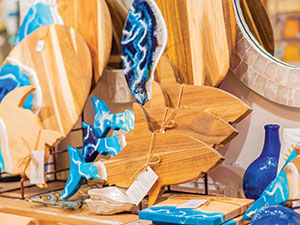
Colorful oyster decor and fish-shaped cutting boards pop on the displays at Mellow Monkey.
Custom collaborations play a key role. For example, when Aspinwall and his wife, Kristianne, met Second Chance Art at Atlanta Market, they were drawn to the husband-and-wife team’s lighted vintage map signs. Rather than a single map, Aspinwall asked for a piece with enough openings to capture the Metro-North Railroad stations.
A vast selection of irreverent cards and funny greetings by Compendium entice guests to leave with a stack. Aspinwall’s not exaggerating when he says people “drop $150 easily” on cards. “They’re not Hallmark.”
Rivalry fuels loyalty — and sales. “What competition?” Aspinwall asks, half joking, half not. “We’re anything but the ordinary.”
Pull, don’t push
Aspinwall often references what he calls “the pull effect” — a version of what architect Kevin Ervin Kelley describes as The Bonfire Effect: the idea that people are drawn to places that foster emotional connection and shared experience.
“You probably wouldn’t have made a journey here unless someone told you about a really great experience they had,” says Aspinwall, distilling the bonfire effect to a single word: community. “Our products bring people together in the store and people return with ‘newbies’ who have never been here, and we see this all the time.”
Aspinwall adds, “We can carry the best products in the world and offer the best prices, but if the experience you have shopping with us isn’t that great, you won’t want to come back or tell others.”
Aspinwall never pushes products. He pulls customers in by giving them a reason to come back. Meanwhile, the average bag size is 20 to 30 items per transaction and double during the holidays.
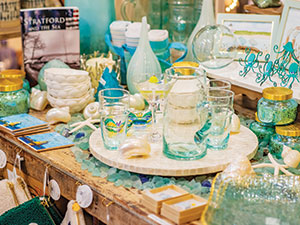
A selection of coastal-themed drinkware and coasters are on display to give customers inspiration for their homes.
How does the shop entice guests to check out a menagerie of purchases? It’s emotional. At the end of the day, Aspinwall wants to make people feel better than they did before they walked in.
“I have so many customers who come in here and tell me they’ve had crap day. They say, ‘I came here because I knew I’d be in a better mood when I left,’” he says. “To me, that’s the best endorsement ever.”
Lots of looks
Avant-garde tablescapes tell themed, layered stories and Aspinwall leans on his art background and hands-on nature to direct whimsical presentations. He likens the process to pairing ingredients in a recipe. “You put them all together to make something great,” he says.
One showroom is focused on holiday, another is centered on coastal products and a third space includes cards, apparel, name drop and more, all in varying price points. Rearranging happens all the time.
Staff are trained to “not be helicopters” — no pushing. Instead, they read the room. “We watch to see what people are doing in the store to determine if they need guiding or not,” says Aspinwall.
Most want to explore.
“We even have signs that remind people to ‘look up’ as they are shopping,” he adds. “We also offer self-guidance tools, including for items we don’t want them to handle because they are highly fragile with instructions to push a button to ring a bell for help.”
Experience has been never more important considering touch-and-go tariffs, inflation, cost of living hikes and consumer spending lulls.
But with the right place, retail mojo and “reason to be in your store,” business marches on to a strong beat.