Beach towns change. Stores turn over. Trends come and go. But on Siesta Key — a barrier-island destination in Florida known for white quartz sand — one retailer has sustained an “everything beach” presence for more than 40 years.
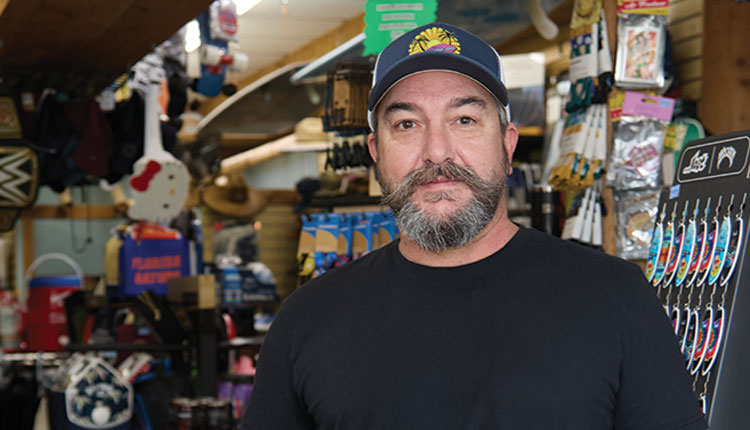
“We’re fun, casual, laid-back and we try to offer a little bit of everything for everyone,” says Wendall Jacobsen, who started working at Beach Bazaar in 1991 when he was 16 years old and never left.
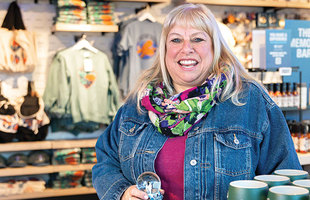
Today, Jacobsen is a partner with the founders, Sue and Mike Balas, continuing a Sun Coast tradition for generations of families that appreciate the store’s souvenirs, surf brands, swimsuits and T-shirts. The 6,000-square-foot, four-room coastal emporium in the Siesta Village shopping district is an extension of the beach experience for locals, snowbirds and tourists.
Photos: Kris Janovitz
And just as Beach Bazaar is not your typical coastal gift shop, Siesta Key differs from many coastal towns because nearly all accommodations are condos — not hotels, Jacobsen points out.
“That means families return year after year, often staying in the same unit, passing it down through generations,” Jacobsen says. “We’ve watched families grow up shopping at Beach Bazaar. It’s pretty special.”
Jacobsen has helped steer the ever-evolving store through retail transitions and challenges, including Hurricane Milton in 2024, which flooded the building and eroded displays that he and the team expeditiously rebuilt, reopening in just over three weeks.
The shop’s longevity is no accident. It’s the result of vision, reinvention, resilience and the kind of community involvement that anchors a business.
“It’s about really listening to your customers — and you have to be willing to change with the times and take some risks,” he says.
Making a mainstay
Beach Bazaar’s business timeline started before its brick-and-mortar presence, when the Balases traveled the Florida fair circuit, personalizing hats. After hopping up and down the coast, they settled in Siesta Key and found a promising cluster of small storefronts anchored by a gas station. This was the “landfall” for Beach Bazaar.
Back then, the strip included four stores and Beach Bazaar set up shop in one of them.
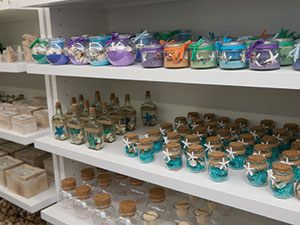
Colorful name-drop sand mementos line some shelves at Beach Bazaar.
Over time, the business expanded, and by 2001, the Balases had acquired all of the shops and the old Citgo station to create one big bazaar.
Originally, it was known as a beach shop with impulse items, souvenirs and accessories. But with the store’s expansion, the buying approach pushed boundaries.
That evolution included curated surf and swim brands. This move required pushing into a market that at first wasn’t so sure about repping their brands in a venue more known for flip-flops and name-drop tees.
“Many of the bigger surf companies wanted specialty surf or skate retailers,” Jacobsen relates. “We were known as a beach store, so we were looked down on a bit when we started in surf.”
But over time, Reef and other surf sandal brands took a chance on Beach Bazaar. Billabong, Rusty, Salt Life and Life Is Good followed. “Vendors saw the volume we could move and tourism here was growing,” Jacobsen says.
Today, Beach Bazaar balances both sides of the coastal retail equation: the branded lifestyle apparel customers seek and the name-drop souvenirs they expect.
Inside the bazaar
Each Beach Bazaar department has its own identity, but the floor plan guides customers through dedicated spaces for easy navigation.
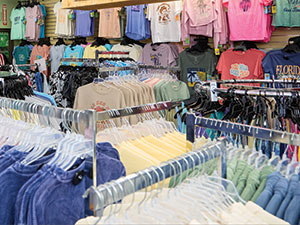
A lot of the souvenir T-shirts are kept together on racks in one of the four rooms of Beach Bazaar for a convenient shopping experience.
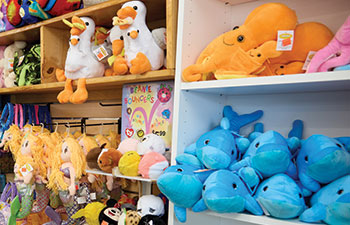
Aside from the Surf Shop, a playful, high-traffic front is stocked with souvenirs and beach essentials. American Gift Corp. is a key supplier, as are toys by Barry-Owen Co. and Fun Stuff Inc., ranging from die-cast cars, popular 3D-printed animals and rubber sea creatures. Games move from shelves, especially on rainy days.
The mid-store area blends island apparel basics and resort wear. It’s often the busiest space, where families pick up matching shirts, sweatshirts and vacation keepsakes. Displays are stocked with name-drop tees, sweatshirts and accessories tailored to Siesta Key’s visitors, many of whom come from the Midwest.
“We sell a lot of sweatshirts for that reason,” says Jacobsen.
Apparel spans across brands including Lakeshirts, Yesterdays Sportswear, L2 Brands, Cabana Life and others, with a growing resort wear presence. Meanwhile, coolers are huge sellers. Beach Bazaar moves all sizes of Kanga Coolers, Igloos and Corkcicle and positions these products by adjacent items like Tervis drinkware.
Meanwhile, the Swim Shop showcases surf swim brands like Roxy, Sunset Separates, Maaji, Body Glove, Rip Curl and an expanding selection that includes Beach House and Roka.
This store-within-a-store offers an elevated shopping department for sought-after brands, Jacobsen says.
All rooms have separate POS stations. “Spring and summer get very busy, so we make checkout as efficient as possible,” Jacobsen says.
Weathering storms
In fact, efficiency and resiliency are key in this beach town. Jacobsen reflects to October 2024 when Siesta Key took a direct hit from Hurricane Milton. “We had 18 inches of water inside the store,” he says. “Hundreds of thousands of dollars in inventory were destroyed.”
Though Beach Bazaar followed its standard hurricane protocol, this time, it wasn’t enough. “They always tell you the streets will flood and they never do,” he says. “This time, they did.”
Particle-board racks swelled and disintegrated. Drywall had to be torn out. Slatwall buckled. With no power and high humidity, mold set in almost instantly. A positive: the building’s rugged concrete block construction.
“We rebuilt much of it ourselves,” Jacobsen says of the interior rehab.
The store maintained steady payroll to its 37 full-time, year-round team members rather than paying outside contractors for a rebuild. The reopening was all about the store’s people. “We wanted them working, feeling normal again,” says Jacobsen.
The island itself faced months of recovery. About 1,600 vacation units were offline due to damage, elevator failures and structural concerns. Media coverage painted the island as “destroyed,” hurting visitation even after businesses reopened.
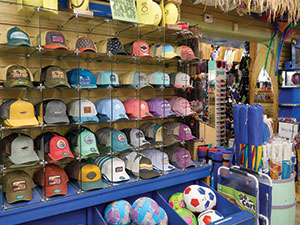
Different styles of caps are kept neatly organized in cubbies.
“We did everything we could to dispel the narrative,” Jacobsen says. “We showed photos of the beach, the progress, the store — anything to remind people we were still here.”
The local chamber supported cleanup crews, coordinated supplies and worked tirelessly to correct misinformation. “It taught us a lot,” Jacobsen says. “Expect the worst, hope for the best and be better prepared.”
There is a generosity to the culture, mirrored in how vendors responded after the hurricane, Jacobsen emphasizes. “All of my sales reps reached out personally to check on us,” he says. “In difficult times, relationships matter. They help you get through.”
A community anchor
Beach Bazaar’s presence on Siesta Key extends beyond retail. Jacobsen is a longtime board member and past president of the Siesta Key Chamber of Commerce.
“Being a staple in the community means being involved,” he says. “I like having a say in what’s happening on the island. And for Beach Bazaar, it’s part of our duty.”
Jacobsen also serves as chairman of the board for Casting for the Kids, a Sarasota nonprofit supporting families facing pediatric cancer. The store promotes the nonprofit and donates through sales of his apparel brand Floridified. Beach Bazaar also encourages shoppers to scan a QR code to give year-round.
For Jacobsen, who’s ingrained in the Siesta Key retail business and nonprofit communities, Beach Bazaar is home.
“Being part of Siesta Key means something to us,” Jacobsen says. “We’re proud of where we are — and proud to still be here.”