What do The Beach Boys, Gidget, sun-bleached surfboards and an indie oceanside San Diego museum have in common?
They all helped shape the modern surfing story — one California Surf Museum has spent nearly four decades preserving. What began as a handful of surf historians meeting over meals in Cardiff-by-the-Sea has evolved into a cultural landmark where history, community and coastal nostalgia collide.
The museum’s mission — to preserve, protect and share surfing’s heritage for future generations — runs through every exhibition, artifact and event. But it also lives in a surprising place: the compact, carefully curated gift store that has grown into the museum’s second-largest revenue source. More than a takeaway counter or tourist stop, the store acts as a continuation of the visitor experience, extending the nostalgia and curiosity sparked on the exhibit floor.
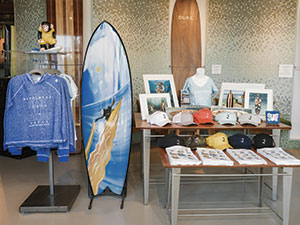
A surfboard draws customers toward a table of caps.
photos: Holly Sigafoos
Executive Director Jim Kempton, a former surf journalist and longtime historian, says the museum store’s success propels the institution’s sustainability and growth. When the museum moved into its current home in 2008 — part of Oceanside’s revitalization — the grassroots nonprofit finally had space to build a true museum store.
“We were able to put in a really serious gift shop,” Kempton says. “And we brought in someone who understood retail.”
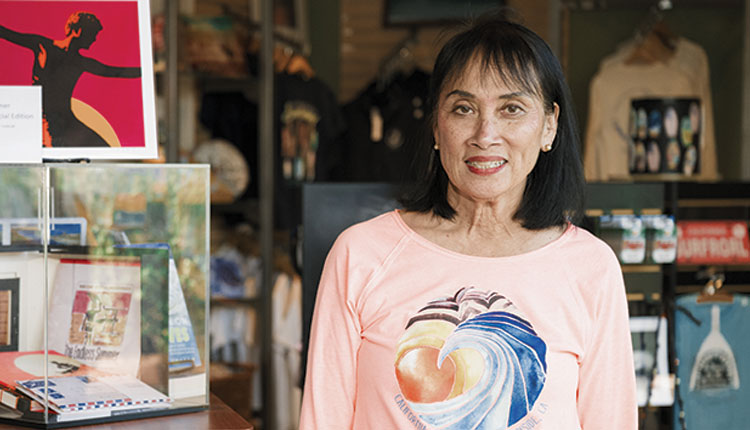
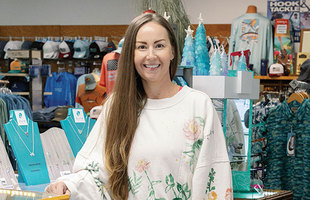
That someone was Camille Cacas, the museum’s retail director and buyer, who has shaped the store for the past 11 years. She had spent a life’s career in retail, owning a Hallmark store, working with independent drugstores and serving as a rep at LA Mart. She saw an ad on Craigslist when the museum decided to focus on retail.
“Why not?” she thought, encouraged by her now-husband, a surf enthusiast.
Surf culture, community and retail ride the same wave at California Surf Museum, and Cacas steers a nostalgic shop that supports its mission. “Eighty percent of our visitors don’t even surf, but they grew up listening to The Beach Boys, they skateboarded and saw movies like Endless Summer,” she says of the “big draw.”
Curating a collection
After managing retail from all fronts of the industry, Cacas walked into the California Surf Museum shop with a practiced eye. She knew what needed to change.
The earlier iteration of the store leaned more surf-shop than museum — logo-light, category-light and missing the emotional resonance that motivates museum shoppers.
“I remember saying, ‘We’re not a surf shop. We’re a museum store,’” Cacas recalls. “Visitors walk through the exhibits first. They’re moved. They’re inspired. The store should reflect that.”
And it does. Today, the 600-square-foot space is modest in size but diversly stocked with layers of gifts and souvenirs, from artwork to apparel and handcrafted coastal goods. It’s also one of the most efficient corners of the museum, generating consistent year-over-year growth and playing a meaningful role in funding programs, staffing and exhibits.
Much of the store’s success began with the museum’s graphic identity: a distinctive surfer silhouette created through a community design contest. The logo appears across best-selling apparel produced by Impact Design.
“We sell apparel like any coastal museum would,” Cacas says. “But put our logo on it, and the value doubles. During COVID, when gift shops were struggling, we still had people coming in because they wanted the shirts.”
Visitors gravitate toward the soft, beach-ready fabrics in short sleeves, long sleeves and French terry hoodies. Rotating graphics keep the assortment fresh without straying too far from what members expect.
Hats are mostly classic baseball cap style. “Our audience leans older,” Cacas says of a demographic that’s more interested in traditional headwear vs. trucker hats, though the shop does carry some.
If there’s one product category that Cacas can count on, it’s impulse items tied to both aesthetics and portability.
Paper Sharks tea towels — lightweight, lint-free and customized with the museum’s name — have become go-to souvenirs. “People can fold them small, toss them in luggage, and pick up multiples as gifts,” Cacas says.
Ipswich Soaps, wrapped in labels featuring VW vans, Woodies and retro surf girls are another reliable seller. Cacas merchandises them alongside the towels on a tiered table, a high-traffic, easy-reach display that anchors the front of the shop.
Nostalgia sells
Nostalgia drives nearly every category in the store, but it’s especially strong in jewelry. Two artisan lines — Left Hand Studios and D’Ears — anchor the department with coastal motifs: waves, sunsets, hibiscus flowers, surfboards and sea turtles.
Placement matters. Left Hand Studios sits at the front register for visibility and security, while D’Ears jewelry pieces hang on pegs nearby for easy browsing.
St. Christopher medallions are a surprise hit. They were once given as tokens of affection or “going steady,” and Cacas says, “It’s always fun hearing parents explain them to kids.”
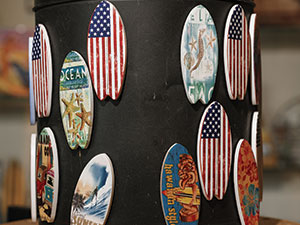
Customers enjoy the store’s magnets shaped like surfboards.
The museum also sells a range of educational and art-driven merchandise, including Safari Ltd. ocean tubes, coastal plush and posters linked to its exhibits. Ocean artist Wade Koniakowsky’s “Surf Art” poster series is a top seller for the current exhibition, while the iconic Endless Summer poster and its metal reproduction are perennial favorites.
Meanwhile, some of the most popular items aren’t purchased from vendors at all. They’re donated. The museum’s vintage Hawaiian shirt rack is filled with aloha shirts dropped off by members and visitors and have become a cult favorite. Shirts are priced at $19.95, regardless of label, and rotated continually based on what comes through the door.
“We probably have 30 to 45 shirts at any time,” Cacas says. “People come here every summer before checking into their hotel to see what we’ve got. It’s become a thing.”
Labels range from Hilo Hattie to Reyn Spooner to Tommy Bahama, and the assortment changes daily. For visitors, it’s treasure hunting. For the museum, it’s pure margin.
Supporting the surf story
With just two full-time employees, two part-timers and a strong volunteer team, the museum store is a lean operation, Cacas says. Staff who greet visitors, support events or guide tours can also run the register, maximizing payroll.
“Our goal has always been to have the store cover payroll,” Kempton says. “It’s a tall task, but Camille has moved us closer every year.”
Cacas says she uses the same business principles she relied on earlier in her career. “You plan for rushes and lulls,” she explains. “You keep your margins healthy. You watch your numbers.”
Visitors come from Brazil, Portugal, France, Japan — and from local beach towns up and down the coast. Many come for exhibits. Others stop in just for the gift shop. Most leave with both an appreciation for surf history and a purchase that supports the museum, says Cacas.
And as the California Surf Museum approaches its 40th anniversary — just shy of the 50-year mark often considered the threshold of institutional legacy, Kempton points out — retail plays an integral role in everyday operations and planning for the future. Exhibits continue to expand. Visitors continue to grow.
The store, under Cacas’ watch, continues to deepen the connection between surf culture and the people who love it. “It’s the positive vibe,” she says. “People walk in, they see the boards, the art, the timeline — and they just light up. Then they find something in the store that brings that feeling home.”