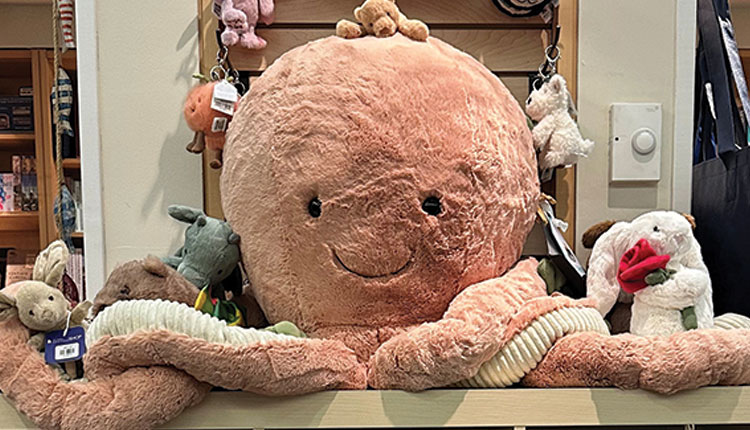
They’re TikTok famous and star in Instagram posts. They’re also large and in charge of encouraging visitors to browse a seabed of marine-themed plush. At the New Bedford Whaling Museum gift shop, two prominent Jellycat characters anchor an array of squishy finds.
There’s the gigantic Gilbert the Great Blue Whale, who sports his own employee name badge. Then there’s the apricot-colored Odell the Octopus, a stand-out character in her own right.
Together, they’re a whopping presence in the gift shop, which carries just one of these super-sized softies at a time. Their smaller “twins” are showcased next to the big icons on multi-tier round displays.
“Gilbert is the crown jewel of our plush collection,” says Julie O’Boy, visitor experience supervisor at the New Bedford, Massachusetts, shop.
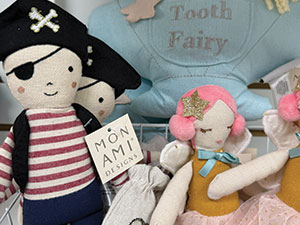
Tate & Tilly carries an assortment of coastal plush, including pirates and fairies.
As for Gilbert and Odell, while not so simple to wrap up and travel home with, they spark conversation and inspire exploration in the shop, where plush is a staple and presented in themed displays that align with museum highlights and special exhibitions.
Relevant and ready to squeeze, plush displays lure in guests of all ages, and especially the younger set, O’Boy says, relating the importance of positioning plush in ways that allow guests to touch and feel.
After all, plush is a tactile souvenir.
O’Boy says, “It’s about finding different stuffed animals that people will gravitate toward that tie into something they experienced here.”
Plush pairings
Gathered in a just-soft-stuff display or dispersed among similar themed toys and games, plush presentation strategies vary across retailers — and within a single store’s footprint. At Tate & Tilly in Tampa, Florida, owner Amy McDermott creates some brand-exclusive displays and other combination presentations, such as propping up plush with books, games and baby apparel.
It’s all about “gifts, gifts, gifts,” says McDermott, explaining Tate & Tilly’s goal to inspire customers’ curiosity so they travel from one display to the next, bagging items at each.
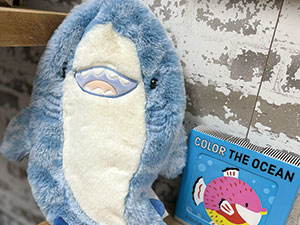
Tate & Tilly showcases a shark plush alongside a sea-themed book.
Jellycat stands alone. So do Warmies, and McDermott switches up this wearable storyline for different seasons. “During the holidays, we carry penguins, Santa and snowmen, and in the spring the display might include bumblebees or dogs,” she says.
Coastal-themed plush are perennial sellers, says Hollie Perkins, buyer for baby and kids at Tate & Tilly.
Alligators and sharks move quickly from the shelves. “We try to keep a variety of coastal plush, such as the flamingo, manatee, turtle, dolphin and octopus,” she relates. “They all continue to sell really well, especially when there is a book paired with the plush.”
As for stand-alone displays, Warmies also have a dedicated display at Lazy Days of Longville, where owner Carrie Jorgensen says the microwaveable plush spark an instant connection at the Longville, Minnesota shop. “They’re a soothing, sensory experience and people seem to know and recognize the brand,” Jorgensen says.
With a brand-centric approach, retailers can leverage store positioning to lure customers from the entrance to displays in farther-reaching spots to create a buying journey.
Because Tate & Tilly fields at least one call daily about the shop’s Jellycat inventory, which is touch-and-go with supply — a reality for retailers across the country — she opts for a back-of-store home for this line.
“It’s not just the younger kids, we have college kids and high-school boys buying them for their girlfriends,” McDermott relates.
Tate & Tilly also employs a stuffed octopus that retails for about $800 as a display fixture. It hovers over a display of plush, books and related products from the brand, with a cubby system making finding a stuffie super convenient.
Mixing up displays also inspires more purchases. “I love remerchandising and making a display seem new just by moving a product to a different spot,” says McDermott.
Stuffing in more sales
Plush tells a conservation story at The New Bedford Whaling Museum shop with offerings such as Call For The Wild sets that group animals with accessories such as an air lift mimicking how marine biologists would help a stranded sea creature.
Across the board, displays featuring plush by brands like Douglas and Wild Republic are reminders to guests of the marine life they visited at the museum.
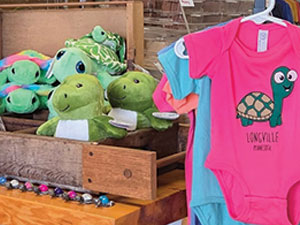
Turtle plush help to accent display tables with related turtle-themed merchandise at Lazy Days of Longville.
Jorgensen shapes some displays based on local happenings in Longville. For example, during the annual Turtle Fest, a main display combines plush turtles of all sizes and styles with other gifts in a turtle motif such as stickers, cards and notepads. A year-round loon display gets the same treatment.
At the same time, turtles and loons are positioned in the children’s toy area at the back of the shop.
Jorgensen also maintains a consistent stock of popular mermaid plush that sell alongside other lake motif plush.
“You can find plush in both places,” says Jorgensen. “We put plush on lower shelves or in baskets on the floor so they not only see it, but they can also grab it and hold it to make sure it’s the one they want.”
A section of Tate & Tilly that’s centered on baby and tween is where most of the shop’s plush is arranged. In this way, plush becomes a suggestion. “Plush is timeless and a great gift — or a great add-on gift,” McDermott points out. “A customer might buy a cute bumblebee onesie and then they can grab the coordinating stuffie that’s right next to it.”
Plush mingle with puzzles, playsets, books and crafts at Pebbles Toys & Gifts in New Haven, Connecticut, plush. Store Manager Lauren Coleman focuses on sourcing specialty products that veer away from big-box and major online retailers and she applies the same filter when inviting plush to Pebbles’ displays.
Displays are curated to guests’ interests and seasonally relevant gifts. Coleman’s theme-based presentation strategy throughout the store extends to plush selections, which are curated to align with the time of year. “We are firm believers in giving beautiful things to children,” says Coleman.