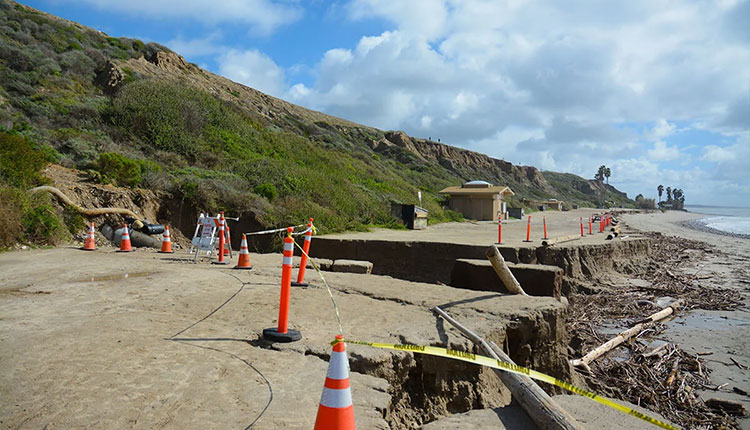
The Surfrider Foundation has released its 2026 State of the Beach Report to analyze the future of U.S. coastlines, zooming in on the current state of coastal management practices such as emergency shoreline armoring.
The report states that beaches and coastal areas across the nation have been in a near constant state of emergency this year, with many of these coasts at a turning point. The organization cites El Niño, Pacific hurricanes, erosion and other extreme weather anomalies impacting U.S. coastlines.
“As these ‘emergencies’ become more common along our shores, the state policy frameworks developed to allow emergency armoring to protect life and property in coastal areas, many decades old, are unintentionally contributing to the permanent loss of our beaches by enabling temporary emergency armoring to become permanent structures,” Surfrider Foundation shares. “Worse, in some states, temporary armoring simply becomes permanent due to a lack of enforcement that fails to remove temporary structures within a legally defined timeframe. This temporary-to-permanent permit pipeline is making our beaches more vulnerable to irreversible losses in the future.”
According to Surfrider Foundation, 90% of coastal states earned a “C” or worse for their state laws and rules for emergency shoreline armoring. Only Connecticut, Oregon and Texas earned a B. Five states — including Alaska, Maryland, Minnesota, Mississippi and Wisconsin — earned an F. In all, 40% of states have failed to put minimum safeguards into law.
The report also documents the issues with temporary-to-permanent permit pipelines. When emergencies are declared, armoring often is put in place along coastlines with weak limits on its size, type and duration. Oftentimes, these temporary structures become permanent structures and are converted to permanent permits. Surfrider Foundation reports that once hard structures are in place, the beach is pinned in place, and upland sand replenishment is cut off. This causes erosion to accelerate on neighboring properties, creating a need for new rounds of armoring. Many states are investing in long-term sea level rise and adaptation planning, but emergency rules that reward storm-by-storm armoring can quickly undermine those plans.
Surfrider Foundation cites some examples of this from across the country. In Hawaii, sandbags authorized in 2007 as a three-year fix at a West Maui condominium complex remain on the beach nearly two decades later, and shoreline armoring has contributed to the loss of more than 13 miles of beach statewide. In San Clemente, California, a series of emergency permits since 2021 have led to the placement of almost 27,000 tons of riprap along a rail corridor, turning the beach into an impassable pile of boulders.
“The state of our beaches doesn’t have to be a state of emergency. El Niño isn’t a surprise. It’s a recurring, well-forecast weather pattern, and we’ve watched this one build for months,” says Emma Haydocy, Surfrider’s Coasts & Climate Initiative senior manager. “When a forecast weather or tidal pattern is treated as an emergency, rock and concrete go onto the beach with little review or oversight, and too often they become permanent fixtures along our shores.”
Surfrider Foundation says coastal states can take steps to fix these problems. The organization suggests that states governments should:
- Redefine emergencies to exclude forecasted hazards such as predicted storms, king tides and sea level rise
- Require written authorization in advance, ideally issued on-site after an agency inspection
- Prioritize removal and restoration on beaches, limiting emergency structures to a maximum of two years
- Trigger long-term erosion responses so an emergency permit leads to nature-based solutions, such as dune restoration, living shorelines and planned relocation
The nonprofit organization says some momentum for change is building, though. In 2026, Florida enacted a coastal resiliency law, SB 302, that elevates nature-based solutions for coastal resiliency, and Hawaii’s Board of Land and Natural Resources signaled a shift away from rubber-stamping repeated emergency extensions. Oregon is also updating its emergency armoring rules, with Surfrider Foundation serving on the rules advisory committee.
“States can fix this by defining emergencies more narrowly, enforcing laws that require temporary structures to actually be removed, and proactively planning for long-term coastal resilience,” Haydocy adds. “An emergency permit should buy time for meaningful adaptation — not become a poor substitute for it.”
Surfrider's full State of the Beach Report can be found online at www.surfrider.org.


