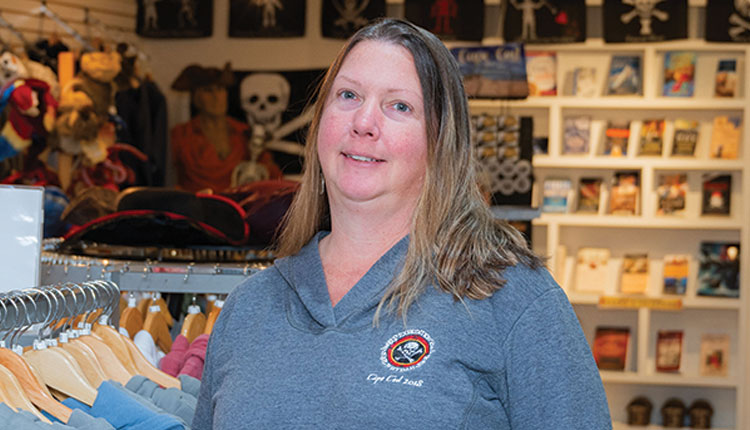
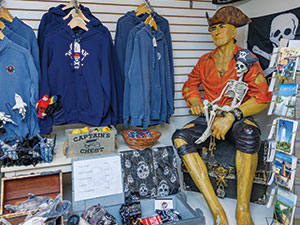
Gifts and pirate-themed booty in this gift shop all relate back to the museum mission.
The story begins with a bell. Recovered from the ocean floor off Cape Cod in the mid-1980s, the inscription on the bell, 1716, confirmed what divers had hoped they had found: the Whydah Gally, the only authenticated pirate shipwreck ever discovered.
“We’re home to the world’s only verified pirate treasure,” says Meredith Katz, executive director. “Other wrecks have been found, but none had the telltale artifact.”
Nearly four decades later, the search continues. Archaeologists are still recovering artifacts from the wreck site buried beneath approximately 30 feet of shifting sand off the coast of Wellfleet, Massachusetts. Every dive has the potential to reveal another piece of history from the pirate ship captained by Sam Bellamy before it sank during a violent storm in 1717.
This ongoing discovery is what makes the Whydah Pirate Museum in West Yarmouth, Massachusetts, unlike other pirate attractions. Visitors can witness archaeology in progress.
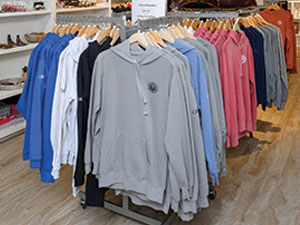 The store carries classic name-drop sweatshirts. photos: Bryan Stearns Inside the museum, galleries showcase thousands of artifacts recovered from the wreck, from gold and silver coins to navigational instruments, weapons and personal belongings that paint a remarkably detailed picture of life aboard an early 18th-century pirate ship. Nearby, conservation specialists painstakingly free artifacts from centuries-old concretions, revealing objects that haven’t seen daylight in more than 300 years.
The experience continues inside the museum store, where every purchase helps support future expeditions and artifact conservation.
“Everything goes back to the dive and research,” Katz says. “We’re still actively excavating, and every purchase helps fund that work.”
More than pirate loreThe Whydah’s story is extraordinary because it’s documented history. “It’s real history, not folklore,” Katz says.
Originally built as a slave ship, the Whydah was captured in 1717 by pirate Samuel “Black Sam” Bellamy and his crew during one of the most successful pirate campaigns in history. Just months later, the ship was lost in a nor’easter off Cape Cod with all but two of the approximately 146 crew members perishing.
For years, the wreck existed largely as a tale.
This changed when underwater explorer Barry Clifford located the site in 1984 after years of searching.
“The museum is a life’s passion for our founder, Barry Clifford,” Katz says. “His dream was to find pirates’ treasure along the Cape, and he almost gave up until one last dive in 1984 with his buddy, John F. Kennedy Jr. It was a lucky day. The next year they unearthed one of the Whydah’s anchors, and finally the bell. Dives continue today.”
The museum stands as the public face of Clifford’s lifelong mission.
And despite thousands of recovered artifacts filling nearly 8,000 square feet of exhibit space, Katz says researchers have only scratched the surface.
“Only about 10% of the claimed treasure is accounted for,” she says. “There’s still so much history waiting beneath the sand.”
Digging up detailsGuests often arrive expecting tales of pirates and buried treasure. What many don’t expect is the science.
“The lab surprises people the most,” Katz says. “Every artifact starts inside a concretion, basically a rock. Our archaeologists X-ray them, identify what’s inside and gradually free each piece.”
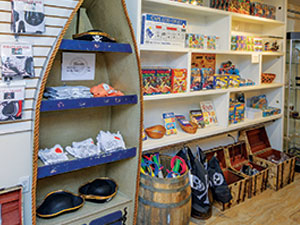 A bookshelf in the silhouette of a boat displays some kids’ merchandise. Visitors can watch conservators carefully chip away at concretions, exposing coins, buckles, tools and other artifacts that would otherwise remain hidden. The meticulous work requires patience, specialized equipment and years of expertise.
This behind-the-scenes access and authentic exhibits cast off an adventure that continues in the museum store.
“I’m very intentional,” Katz says of buying for the gift shop. “I don’t buy every pirate item out there. We focus on quality and pieces that tie back to our mission.”
For example, the museum developed its own Expedition Whydah apparel collection featuring original ship artwork and museum branding. Custom postcards, magnets, stickers and patches allow visitors to take home pieces that commemorate the experience while supporting ongoing research.
One of the most popular items tells the museum’s story in an unexpected way. “Our color-changing mug is a best-seller,” Katz says. “It starts off black and has our logo in silver or gold. When you add hot water, the Whydah ship appears.”
The cool mug effect is much like the surprising history guests learn when they visit.
Pirate hats remain another favorite, especially among families eager to capture vacation photos before leaving the museum.”
They’re usually the first thing people grab and put on to take pictures,” Katz says.
Pirate’s bootyChildren naturally gravitate toward the interactive side of the shop. “Our foam swords are absolutely our No. 1 seller,” Katz says. “They’re much safer than the plastic ones we used to carry.”
Custom “booty bags” are another top pick among the younger set. “They’re little sacks filled with plastic coins, gems, rocks and rings,” Katz describes.
Treasure chests, wooden ship kits, telescopes and toy pirate pistols round out the selection. Katz sources many of these from Design Masters. The museum also stocks Folkmanis puppets featuring scarlet macaws, whales and sharks that reflect both pirate lore and Cape Cod’s coastal wildlife.
Adults often head toward collectibles. Magnets and embroidered patches remain consistent favorites, joined by Christmas ornaments depicting pirate ships and Cape Cod themes. The newest addition is a whimsical gingerbread pirate ship ornament that has quickly become a customer favorite, Katz says.
“We try to have something at every price point,” she says. “We want everyone to be able to leave with something, and probably 95% do.”
Seafaring scienceManaging the museum store requires careful planning, especially during Cape Cod’s busy summer season.
“On rainy days we can see more than 1,000 people,” Katz says. “Everything is pre-priced and ready to go in the back room. Our ticket counter is integrated with the shop, so the team handles both.”
Preparation allows the museum to move large crowds through admissions and retail while keeping the focus on the visitor experience.
Also, retail success isn’t measured solely by sales. Every purchase directly supports continued exploration of the Whydah wreck site, conservation of newly recovered artifacts and the research that continues to reshape historians’ understanding of piracy during the early 1700s.
“When someone buys a magnet or a sword or a sweatshirt, they’re supporting archaeology,” says Katz.
Guests leave with more than a souvenir. They become part of an archaeological story that is still being written following their visit.
“A lot of people hear ‘pirates’ and they think this is for little kids,” she relates. “The outside of the building is pretty nondescript, but when you walk in the door, there is a major wow factor.”
|