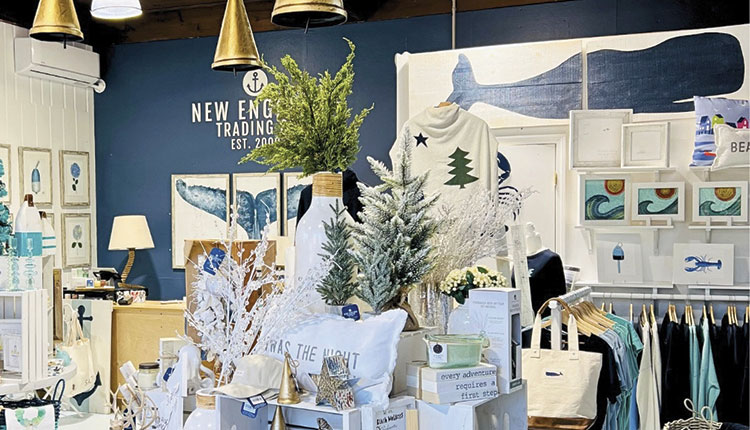
Coastal home decor trends are grounded by the sea, relaxed and relevant without being too bold.
Coastal home decor trends are anything but boring. The appealing style continues to evolve, blending familiar seaside influences with a more elevated, versatile aesthetic. Blue in every shade, paired with soft whites that drift into cream and linen or easy-care cotton still tend to define the category.
Classic motifs also remain part of the mix, from lobsters and oyster shells to whales, but they no longer carry the entire story — anchors aren’t doing all the heavy lifting anymore. Today’s interpretations feel more refined than traditional, creating a look that resonates not only in seaside shops but also with inland visitors looking to bring a touch of the coast home.
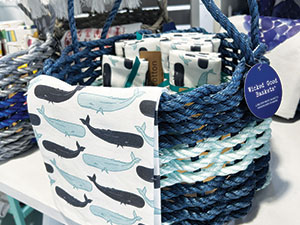 Lobster rope baskets act as a nice accent alongside whale print linens at New England Trading Co. Describing the decor scene at New England Trading Co. in Wells, Maine, Karen Marsh says, “It’s coastal, but it’s not screaming coastal. It’s a nod to the heritage, the culture, but elevated.”
The business she owns with her husband, Jeff, started as a cottage industry by creating Wicked Good Lobster Rope Doormats (as seen on The Today Show). Those expanded to baskets, reclaimed pieces and eventually a shop that has expanded twice this year in anticipation of a robust summer.
Coastal light Coastal decor is decidedly stepping away from the obvious and more toward a mood. Cream Cornwall is a U.K.-based wholesale coastal decor company that has made deep strides into the American coastal market. Proprietor Allison Hughes says the seaside foundation has always been rooted in classic coastal design.
Ongoing are blue and white palettes paired with sea life motifs. But even as the brand introduces new collections, that core identity remains intact.
Buyers want traditional coastal, but they’re also interested in tweaks.
A recent launch inspired by Cornish gardens expands the offering into the garden without abandoning the coastal lens. “You can still have that coastal feeling, even if you’re not by the sea,” Hughes explains.
Versatility is increasingly important. Customers want products that translate across environments, and seaside retailers are responding by focusing on design elements that feel universal with color, material and pattern rather than strictly thematic.
At the same time, there’s a growing comfort with contrast. Kim Hovell sees it in how customers approach tabletop and decor pieces in her Annapolis, Maryland-based shop, Kim Hovell Fine Art, where classic elements are often paired with something more playful.
It’s a coastal decor edit.
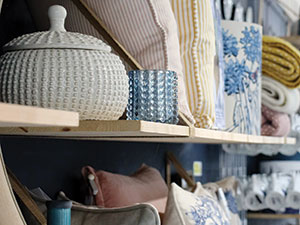 Cream Cornwall combines garden and coastal themes on many of its products. “It’s fun to mix in something a little kitschy with more classic tableware,” she says. “That balance keeps displays from feeling overly polished or predictable. A refined base with neutral linens, painterly artwork and simple ceramics can handle a touch of whimsy, whether it’s a patterned pitcher, a novelty accessory or a small pop of unexpected color.”
This is the case at Coastal Treasures in Bodega Bay, California, where owner Sharon Corbett has merged an interior design career into a distinct stop that prompts visitors to impulse buy because they won’t find these goodies elsewhere.
Textiles range from pillows and throws to tea towels. Glassware is plated together with matching sets amid prints and beach-themed artwork, mostly created in house.
Corbett still runs her interior design firm and finds that fabricating the works in the shop inspires purchases. “I have a little spot I’ve turned into a workshop so I can be at the cash register selling and making slip covers or drapes,” she says, noting the design adjacencies that lead to home decor sales in the shop.
She adds of the draw of unique home decor, “It’s a breath of fresh air when visitors walk in, and I hear them say, ‘Buy it. Where else will you find it?’”
Nature aboundsLately, nature leads, especially in soft and organic forms. We’re seeing pops of garden, especially hydrangeas, and citrus vibes. Cue the lemons and oranges.
Hovell is also noticing strong demand for bird imagery, from herons to migrating species like snow geese, reflecting a broader shift toward wildlife motifs that feel calm and observational rather than decorative.
“I’m painting more birds right now. They’re really resonating,” shares Hovell.
Sea life is a stable seller, but with a more stylized or artistic approach. At Cream Cornwall, the classic octopus and seahorse designs continue to perform across categories, particularly in tabletop items like mugs and textiles.
“The octopus has always been one of our strongest sellers,” Hughes notes, pointing to its distinctive, almost playful movement in the wholesaler’s designs.
Shells are also seeing renewed interest, offering a familiar coastal reference that can be easily integrated into a range of aesthetics.
Color plays an equally important role. While blue and white dominate, retailers are introducing subtle variations to keep assortments dynamic. Soft greens, sandy neutrals and seasonal accents like citrus tones are popping up in layers, often as highlights rather than focal points.
“I’ll bring in a hint of lemon or orange, but it’s always grounded in our core palette,” Marsh says.
Flexibility rules As customers become more intentional in their purchasing, they’re also looking for flexibility and ways to refresh a space without committing to a full redesign.
That’s fueling demand for what retailers might think of as “entry point” decor that includes pieces that are relatively accessible, easy to change and impactful in small doses.
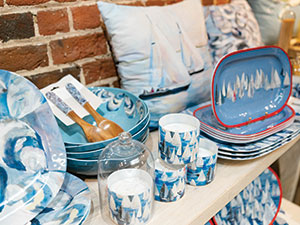 Kim Hovell shows off sailboat-themed serveware. For Hovell, tabletop textiles are a clear example. Table runners and napkins allow customers to shift the look of a dining space with minimal effort, making them both practical and expressive.
“It’s not a huge commitment,” she says. “You can change it depending on your mood or the season.”
Hughes is seeing a similar dynamic with lampshades, which offer an opportunity to introduce pattern or scale without altering the foundation of a room.
“You can be a bit more experimental with a lampshade,” she says. “It’s a great way to change the feel of a space.”
The smallest items take weight.
“We’re playing with cushions, throws, decorative accessories and selling a lot of paperweights,” she says of the glass desk fixtures embodied with jellyfish and octopus that fly off the shelves.
Highly functional items are taking on a more design-forward role. Marsh’s Lobster Rope doormats, for example, serve as both a practical necessity and a visual statement.
She laughs, “I never thought I’d be so obsessed with doormats, and here I am.”
Indeed, there is a following that has branched out to baskets of all sizes and their other homemade brands, including American Farmhouse Bowls.
She partners with lines like Maritime Tribes, Salty Cottage and Center Street Soap Co.
“They have great products that match my story,” says Marsh.
Show it off Storytelling elevates simple product displays and creates must-buy moments that invite customers to imagine how items will live in their own spaces.
Vignettes include layered arrangements that combine multiple product categories into a cohesive scene. A chair paired with a throw and cushion, set beside a small table and lamp, framed by artwork or a mirror, offers a visual narrative.
For Hughes, these setups do more than inspire — they drive sales.
That effect extends to both individual items and overall basket size. When customers can see how pieces work together, they’re more confident in their selections and more likely to purchase multiple items at once.
Marsh approaches merchandising with a similarly immersive mindset, viewing her store as a sequence of connected moments.
This philosophy encourages consistency across the store while still allowing for variation and discovery. Each vignette stands on its own while contributing to a larger narrative that defines the brand.
Visual layering plays a key role here as well. Incorporating height like propping canvases behind tabletop displays or mixing wall art with mirrors adds dimension and interest, helping products stand out.
“Every display is a chapter,” Marsh explains. “It has to support the whole story.”
This more intentional approach to merchandising naturally supports a thoughtful mix of products and price points.
Rather than relying on volume, retailers are focusing on how items relate, pairing statement pieces with smaller, complementary products.
In Hovell’s shop, that might mean combining painted glassware, linens and candles with easy grab-and-go items like salt and pepper shakers or small decorative accents.
“There are a lot of little things you can mix in,” she says, calling out Annapolis Candle and their relationship that introduces custom offerings, a win for customers.
Small statements in home decor matter. They provide entry points for customers, encourage impulse purchases and help build a layered, collected look.
At the same time, inventory strategies are shifting to support flexibility. Hughes emphasizes the value of buying in smaller quantities and refreshing more frequently, allowing retailers to test new products and keep displays feeling current.
“You can buy into something, see how it goes, and then change it up,” she says.
That approach also aligns with how buyers shop. As Marsh observes, customers are prioritizing quality and cohesion over quantity.
“It’s about bringing the feeling of the beach into your home,” says Marsh.
|